Showing posts with label Personal branding. Show all posts

Saturday, August 31, 2013

How to Deal With Confrontation


This isn’t new news, but most people struggle with confrontation. If that’s you, it probably boils down to your very human need to be ‘liked’ by everyone.

Naturally, you want to feel a sense of belonging and when people challenge you and your opinion, or outright disagree with you it can shake that up.

Suddenly you are unsure if this person is accepting, or rejecting you. Suddenly you are not sure if you belong in their little circle or not. Suddenly you feel alone and at sea.

There are a multitude of tactics you can adopt in such circumstances and I’d like to touch on one today.

Let’s start by asking 2 questions:

What is your default position as soon as you are faced with confrontation?

What role do your ‘persecutors’ believe you play?

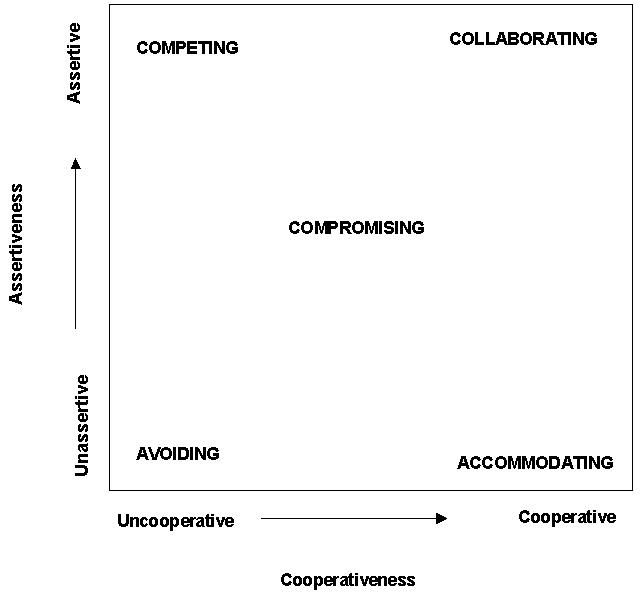
Thomas Kilmann produced an interesting set of options that you might like to consider (TKI Model) above. Here are the options:

Option 1: Do you back down immediately and effectively run away from the problem?
Option 2: Do you accommodate their wishes and berate yourself for ‘being so soft’?
Option 3: Do you spontaneously challenge them back and go round in circles as you butt egos?
Option 4: Do you look for ways in which you could work together to find a solution?

Consider options 1 and 2 above.

If your ‘persecutor’ has come to think of you as someone who will either run away or back down, s/he will smell blood immediately and go in for the kill. As soon as you compromise, you haven’t got a chance.

If you go with option 3, you’ll be butting heads all day.

Which leaves option 4 as the strongest (and only) path to take. And there are plenty of ways in which you can collaborate.

I don’t want to get into those strategies here – that’s for another time. But what I do want you to consider is which of these default positions you naturally choose when faced with confrontation.

And secondly (and perhaps more importantly) which is the position your ‘persecutors’ believe you will take.

You don’t want to be known as a ‘push over’.

You don’t want to be known as a ‘doormat’.

You don’t want to be known either as a ‘hot head’ who will only ever push back when challenged.

What do you think?

I'd love to hear your thoughts!

Rebecca


Monday, August 12, 2013

How to Establish Your Personal Brand BEFORE Any First Meeting


Your personal brand exists purely in the minds of the people you interact with, be that your clients, managers, recruiters, friends or children.


In the words of Jeff Bezos, the founder of Amazon, "Your brand is what people say about you when you’re not in the room".

When it comes to first impressions in business you have a wealth of tools that you can draw on to help support the image you wish to convey before you've even engaged in your first handshake.

Here are my top 10 tools to build your 'first impressions' personal branding arsenal. Use them to demonstrate your professionalism, value-add and expertise and you're much more likely to build trust and credibility from the start:


1. CV

It's never been good enough to have a drab CV. Thesedays you simply can't afford to be a wallflower; the competition is just too fierce. And a recruiter - or potential employer - sifting through a stack of CVs during her tea break doesn't have the time, or interest, to reach page 3 of your CV to read the juiciest, attention grabbing stuff. My advice? Make your first paragraph count. Cram it with 3-5 high impact statements that really sell your value, and potential value, to your reader.


2. Email address

A big bug bear of mine is unprofessional email addresses. If giving out a personal email address why use, littlemisspiggy@yahoo.com when you can have an address like this: andreamurray@yahoo.com? It would be easy for people to make a negative judgment about the first one but not about the second. Simple.


3. Your Advocates

Think about who you want talking about and representing your brand. The referees you choose for your CV for example say a lot about you. If your referee is a CEO a recruiter might think, "This candidate is well connected," or "This person has credibility." Think too about who is talking about you - do they have credibility? Do you want to be associated with them?


4. Your Reputation

What are you known for? If you were to think about the most influential, or well-known people you work with the chances are, some sort of 'value-proposition' comes to mind. Perhaps s/he is a 'go-to' person for something in particular? Or s/he is the most knowledgeable on a specialist topic? What is your reputation built on? What do people think of when they think of you?


5. Your Social Media profiles

You know as well as I do that it matters what you post online. Does your LinkedIn profile truly reflect your achievements to date? Is your facebook profile embarrassing? Are you tweeting endlessly and if so, what are you saying? Are your social media antics beneficial, or a career limiting fiasco?


6. Blog or website

It's becoming more and more common for regular 'careerists' to have their own websites and blogs. Why? Because they're a great tool to demonstrate your expertise and value. And I LOVE that! And even if you've only just started out writing a blog or you have a really simple website, that still tells me you have guts and initiative and helps establish a positive perception of you.


7. Video or audio

If you really want to stand out from the crowd, why not record yourself sharing an idea or opinion about something topical? Video CVs will probably come to replace the traditional paper and online versions so get ahead of the game; you could even post your videos on your blog!


8. Portfolio

A physical portfolio, to showcase your work and ideas, is a tool few people use which makes it highly valuable. If you are in the graphic arts or media industries you may be using one already but if you're in accounting, law, finance you might not have considered how powerful a weapon a portfolio can be. Demonstrate your expertise and knowledge through articles written about industry issues. If you've had these published in trade magazines or on your in-house company intranet, all the better but your unpublished thought pieces are also gold.


9. Business card


Your business card has the power to make or break a first meeting. Your aim is to establish credibility quickly so if your card is bland, or printed on poor quality paper stock, you might want to rethink it. A job title can also help establish your authority or memorability. My friend Ben is owner of the Australian Beer and Wine School; his title is 'Head of Liquids'. Yup - that sticks! If you work for a global organisation and you're stuck with your 'safe' corporate card, help it work harder for you by making yourself more memorable (in a positive way, obviously). There are plenty of ways to do that including...

10. Attire and Grooming
My grandfather always said, "You can tell a lot about someone based on their shoes". Are your shoes scuffed or the heels worn? Are your clothes tailored or hanging off you loosely? Do you need a new hairstyle to freshen up your look?


People notice small things and, in the blink of an eye, will make a judgment whether or not they like, respect or trust you.

How can you use any/all of these tools to help you further your career?   What else have you done to create a solid first impression before you have even met a new client or potential employer?   Love to hear your comments - post them below!   Rebecca  
To learn other tips, strategies and ideas like these, to help you build a powerful Personal Brand and advance your career, you'll love to receive 'PRESENCE', my fortnightly ezine. You'll also receive a copy of my special report, 'The Top 5 Mistakes Women Make On Their CVs'. YES! Subscribe me now!

Rebecca Wells is a Career and Executive Coach with a specialism in Personal Branding for Corporate Women. She believes that women are phenomenal and add long lasting commercial value to business and yet often struggle to understand their value or believe deeply in their abilities to succeed. Her coaching programs are designed for talented and savvy professional women who simply need that extra push to achieve their greatest fulfillment and success.

Wednesday, January 23, 2013

5 Tips to Maintain Credibility When Under Fire


Your Personal Brand is one thing. Your Personal Brand under fire is another.

The true test of your Personal Brand comes when you're faced with a crisis:

  • Perhaps you have been challenged on a report you have written
  • Maybe someone has questionned your leadership technique
  • Or someone seems to be trampling your values

Whatever the crisis, it's important to check in with yourself to decide how you want to respond.

And that's the important thing, to check in with yourself first.

All too often, people respond in an empassioned knee jerk way: do first, think later (or not at all).


To maintain your credibility it's vital that you think first and then respond.

Even if you're under pressure to make a decision... you just have to think very, very quickly.

Here are 5 steps to get you focused:

Think

1. What are the absolute facts here?
2. What assumptions am I making?

Respond

3. Ask your counterpart for specifics: you don't want to react to a generalised statement.

So, for example: if the challenge you were faced with ran something like this:

"I think this report you've written is littered with errors."

Instead of assuming he means the entire piece is littered with errors, ask for some more information:

"Ok, to be clear, can you point out exactly what the errors are?"

4. Now, based on his reply, reassess the facts and ask yourself if your counterpart is justified in his claim?

5a. If so, offer to correct the error quickly - speed is important; you don't want an issue lingering on.

5b. If no, push back assertively!

When have you felt challenged and how did you respond? Did you think and then do? What were the outcomes?

- Rebecca


Tuesday, October 9, 2012

Personal Branding Quick Tip 6: Leverage Your Brand To Benefit Others


This, for me, is the cleverest part of our approach to Personal Branding.

I firmly believe that you develop a powerful personal brand for a much greater reason than just furthering your own personal agenda.

My approach to personal branding is very much about leverage: now that you understand the power and influence you have already, as well as the power you can generate in the future, how are you going to use that to best effect?

For some people, they may wish to use their credibility to positively impact their children, "What lessons have I learnt about myself that I can pass onto them?" See past tips if you're unsure.

For other people, it might be about how their influence could be used to further the objectives of their organisation, "How can I command greater respect in our industry, thereby furthering the reputation of my company?"

And for others it may be about how they could further a community cause. Think about how some celebrities use their brand power to raise awareness of charities close to their hearts.

When you truly take action to create outcomes far greater than those to fuel your own agenda, the positive repurcussions on your brand are then multiplied - it's a win/win situation!

- Rebecca

Friday, September 28, 2012

Personal Branding Quick Tip 5: Promote Your Value


Now that you have passion for what you do; love who you are; understand what value you offer the world; and accept it too... it's time to market and promote that value to the people who matter.
 
Why? You might be asking.

Isn't enough for me to know how I make an impact? Surely the key decision makers around me - my manager, the Board - know all this too?
 
The key to success in life I have found, is to assume nothing.
 
  • Assume no-one knows anything about you.
  • Assume no-one has noticed you staying at work late.
  • Assume no-one has observed the insights you add in meetings.
  • Assume no-one has a clue who you are...
...and you're off to a great start!

Promoting your value is a more complex process than I can explain in a 'quick tip' such as this. But the basics are these:
 
Who needs to know about you?
 
We're talking about people who have decision making capabilities: your manager; a senior partner; your clients; your Board
 
How can you get in front of them?
 
Think about coffee meetings, networking opportunities, and social opportunities at work.
 
What do they need to know?
 
Go back to earlier tips about understanding and accepting your value.
 
How can you tell them?
 
What stops most people from 'promoting their value' is a concern they will come across as arrogant.

You can promote yourself and do it authentically: it's a question of defining how you want to come across in a way that works for you.
 
- Rebecca

Tuesday, September 18, 2012

Personal Branding in Distress: Does Your Email Signature Destroy Your Brand?


I've just received an email from a man who shall remain nameless.

The email was vaguely interesting - I say 'vaguely' because there were numerous typos in the text which automatically gets my back up, makes me lose my train of thought and frankly leads me to judge the sender's professionalism.

And then I reached the email signature. Now, I'm all for quirky 'job' titles but this one for me went too far. It read:

Joe Bloggs
Head of Crazy Ideas; Wacky Guy; NFP Benefactor; Ladies' Man

Seriously?

This was an email from 'Joe Bloggs' asking me if I'd be interested in doing a joint venture with his company.

Err, no thanks!

It's funny - 'Joe Bloggs' might be a very interesting candidate for a JV but it's incredible how much this email signature irritated me.

For a start, it's not particularly professional.

Secondly, anyone who wishes to publicise their 'not for profit contributions' in such a lewd way, is clearly in it for all the wrong reasons (in my opinion).

And lastly... Ladies' Man? Come on!

The issue with your email signature is that it's short, sweet and 2-dimensional.

In other words you've got 5 seconds to make a good (or terrible, in this case) impression and it's an opportunity to bring you, a 3D individual, to life.

I think it's important to ensure your email signature is reflective of a brand other people would trust and wish to 'do business' with.

What do you think about email signatures? Are they easy to get wrong? Does it really matter? Am I being overly sensitive??

- Rebecca

Saturday, September 15, 2012

Personal Branding Quick Tip 4: Accept Your Value

 
Last week, we explored what I mean by 'your value' - read that post here.

 
Understanding what you offer the world - through your innate talents, skills, passions and experience - is only the first step.
 
Most people, when faced with a list of all their positive qualities, reject it out of hand:
 
  • "Surely everybody is like that"
  • "Surely everyone can do that"
  • "There's nothing special about me"
 
Well, here's a news flash for you: you are special and you do have an inordinate amount of value to offer.
 
The question is: do you believe in yourself enough?
 
It isn't possible to 'sell' your personal brand (and all the positive qualities and value it contains) to other people if you haven't sold yourself on the prospect first.
 
The confidence and trust other people have in you are formed from the confidence and trust you have in yourself.
 
So chances are, if your confidence in 'self' is only a 4/10, their confidence in you will probably be a 4/10 too.
  
If you have personal objections as to why 'you're not good enough' your absolute first step is to work through those objections with a trained coach.
 
You truly are the only thing that is holding you back.
 
- Rebecca 

Monday, September 3, 2012

Personal Branding Quick Tip 3: Understand your Value


What am I talking about, 'value'?

Each of us has an inordinate amount of talent to offer the world whether it's about solving problems; making others feel good; how you think; or bringing more money through the door.

You are sitting on a mountain of value and, to develop clarity of what your personal brand stands for, it's important to understand what exactly you can offer (and are already offering) the people around you.

The key to this is simple: be honest with yourself. Now is not the time to be bashful!

To keep it easy, focus on just one situation for now, such as work.

1. What do you offer your company in terms of your skills, innate talents and experience to date?

2. Which areas are you under-capitalising on?

3. What can you do that no-one else can?

Knowing why you are such an asset is critical!   Read Tip 2 here: Love Yourself or Give Up Now   Read Tip 1 here: Your Personal Brand Relies on Your Happiness

Sunday, August 26, 2012

Personal Branding Quick Tip 2: Love Yourself or Give Up Now

Now, I know what you're thinking.


You hate the idea that to enjoy a powerful personal brand you need to 'love yourself'. That means being arrogant right? Believe me, this is a very common reaction when I discuss this concept with clients!


It makes sense too that if you feel 'branding' leads to becoming arrogant that the idea of 'loving yourself' would naturally make your stomach turn.


In my view, 'loving yourself' in this context is quite different. Personal branding is about celebrating you: your assets; your talents; and the value you offer the world. And unless you believe you have any of the above, why would you think you could convince anyone else of the fact?


What I've found, working with many clients now on this topic, is that it's fear that really stops anyone from accepting themselves. And what is fear really? It doesn't really exist - and it only gains any fuel when you think about things you're fearful of.


So, here's the challenge: get a pad of paper and write down everything that you love about yourself. It could be how you communicate with others. It might be that you make people laugh. Perhaps you love that you're adventurous. Or that you're a great listener. Really get in touch with everything you believe is special about you. I'd love to hear what you all come up with!

Tuesday, August 21, 2012

4 Steps To Building a Stronger Personal Brand

It actually only takes 1 step to get clearer about what your personal brand can do for you (and for others). So pick your favourite idea from the list below or set yourself a two week challenge and tackle all 4 - go on, why not?! 1. Get clarity about yourself and what matters to you. What do you believe in? What is important to you? What is absolutely non-negotiable? Think about work situations. Personal situations. Consider how you want to be treated by those around you. 2. Know what you are really, really good at. We all have specialties. We all have strengths and innate talents. What are yours? 3. Become proud of your contribution! We all add value both at home and professionally; what value do you add? If you are dissatisfied with your outputs, what needs to change for the fruits of your labour to bring you joy? 4. When you’re ready, it’s important to let others know about you. Life’s crowded and it’s easy to pale into anonymity. Share your opinions with others. And most importantly perhaps: demonstrate your skills, your talents and your value by taking action. What are your thoughts on personal branding? - Rebecca

Saturday, August 18, 2012

Personal Branding Quick Tip 1: Your Personal Brand Depends On Your Happiness


When we look at personal branding strategy for a client, who wishes to raise his or her profile at work, one of the most important factors to understand is whether or not they like what they do for a living. Imagine standing infront of an audience of 500 people - their eyes fixed on you, waiting for you to speak. I am sure you'd agree that task would be a whole lot easier if you were about to speak on a topic you were passionate about. All too often people are looking for quick fixes: ways to bring fulfilment to their work without addressing the biggest question of all: "Am I happy in my job?" Effective personal branding starts when you feel aligned with the goals you are setting; enjoy the environments you find yourself in; get energy from the people you work with; and love the outputs of your day. So before embarking on a personal branding journey ask yourself how happy and fulfilled you are at work. And if you're struggling to find anything positive to say, your first step should be to understand your personal and professional values to see what really matters most to you. - Rebecca

Monday, March 28, 2011

How to Have Your Voice Heard in Meetings


Isn’t it interesting how, when many people are in meetings, they shut down and yet in social situations, they are able to chat away about any topic brought to the table?

I have found, over many years of coaching clients to get ahead in their careers, that three little voices, that pop up in our heads, are the main causes of this fear. I think these thoughts can be summed up here:

- ‘What if… I say something stupid?’
- ‘What if… I say the wrong thing?’
- ‘What if… people think I’m an idiot?’

The reality is, no-one in any meeting will ever have the absolute truth to offer up. Because truth does not exist. All any of us has in a meeting is an opinion.

Even when it comes to statistics (apparently factual, black and white data), two people can skew the numbers to suit their own perspectives and support their points - and therefore have different opinions.

So if you struggle to voice your opinion in meetings, here are some tips to help you make a solid first impression:

1. Spend time thinking about the meeting. Consider the agenda. Who will be there and what might their agendas might be? Think about areas where you are already knowledgeable. Think about the questions you might ask. The stats or facts you could offer.

2. Assess where the Energy Centre is. What on earth am I banging on about, ‘energy centre‘?? There are always people in a room where the energy naturally gravitates. Who are they? Is it the CEO? A client? A Partner? Sit near them. The conversation will naturally centre around them and it is much easier to add your opinion if you are nearby than from the other end of a 12-seater table.

3. Make a point early in the conversation and lean forwards as you speak. It will give your point some added weight and naturally bring you into the conversation.

4. The most important tip of all is: to start. The longer you allow your voice to go unheard in meetings, the harder it will be to build credibility in the group.

If you’d like some help to increase your confidence in meeting environments, speak to Rebecca.

Wednesday, March 9, 2011

A Simple Tip to Influence Those Around You

I went to a fantastic networking event this morning hosted by Kim McGuinness (Network Central). One of the speakers, Mariette Rups Donnelly, was presenting on the topic of 'presence'.


What an interesting subject this is! To get ahead we must each be seen and heard and of course, there are good ways and not so good ways to achieve this.

Many women whom I coach express concern that 'presence' could be misconstrued by others as downright 'arrogance' - certainly this extreme way of being seen is something most people would wish to avoid.

There are a number of techniques to help you establish greater presence in your meetings, with your clients, and around people 'who matter' - and I'd love to share one of Mariette's today.

Mariette explained that to have presence requires you to be present.

This is simple yet highly thought provoking.

Being present implies you are behaving actively. You are consciously making the effort to connect with the people around you and listening (not just hearing) what they have to say.

To raise your profile, a simple action you could take is to work on living in the moment. And giving your full attention.

And one thing that I have certainly learnt: it is much easier to share your view and be heard once your counterpart genuinely feels that you have listened to all they have to say first!

What are your experiences?

- RW

Wednesday, December 22, 2010

Self Promotion: The 7 Vital Ingredients (Part 3 of 3)


We continue our exploration of tools to help you raise your profile at work - here is our last instalment covering:

Foundation 6: Taking ownership
Foundation 7: Career planning


Foundation 6: Taking Ownership

Our penultimate foundation is more of an attitude.

Let me share a story: Debbie sits down at the beginning of the year to consider what her 3 top professional objectives are for the next 12 months. Mary on the other hand drifts through her life, turning up to work every day without knowing how it fits into the big picture.

- Which of these women is more likely to enjoy fulfilment and success at work?
- Who has greater direction?
- Who will find it easier to raise awareness of her proile?

It's up to you to take ownership of your own career and how you spend your time. Are you working towards an objective or merely drifting along? If you're currently a 'drifter' ask what that is costing you weekly, monthly, annually?


Foundation 7: Career Planning

With the right attitudes in place you can become methodical about planning how your career will pan out. Think about the projects you want to work on this year. Think about the people you want to get to know. Think about key decision makers who would be useful to you and your career. Think about the reviews you need to schedule in.

There's no point in waiting for anyone else to do any of this for you - it is absolutely up to you to plan you own career and then take action...

... and then you can relish all your successes!

-RW

Self Promotion: The 7 Vital Ingredients (Part 2 of 3)


Why does self-promotion matter? Because without it you are allowing professional opportunities to pass you by, whether in terms of projects you could be working on or promotion opportunities.

Missing opportunities costs.

If in 12 months’ time you find yourself in the same position you are in today...
- What might that cost you financially?
- What would you be missing out on in terms of a larger monthly salary?
- What would the cumulative annual cost be?
- And how might that affect your confidence longer term?

Here we continue our exploration of the core foundations needed to raise your profile at work, with greater success.

Foundation 4: Identify key stakeholders
Foundation 5: Confidently sell you and your value


Foundation 4: Identify Key Stakeholders and Build Relationships
It’s vital that you pinpoint who the key decision makers and stakeholders are in your organisation. These are the people who can help you progress your career and will be different for everyone.

In some cases key HR personnel are the ones to target. If you have a good manager or someone in the senior staff, who believes in your development then s/he will be a good person to target. Clients can also be good people to build relationships with. Think about it: if a delighted client were to talk about you to your manager, how do you think that could help your chances of future promotion?

Create a strategy to network regularly with these people: maybe you take your client for lunch every 2-3 months; perhaps you schedule a monthly meeting with your manager to fill her in on your recent successes; maybe you identify where these stakeholders network and network there too! And it needn't be complicated: a coffee chat is just as good!

Continue and read about the 5th vital Foundation here!

Tuesday, October 12, 2010

Self Promotion: The 7 Vital Ingredients (Part 1 of 3)


Australian women earn 18% less than men - why is that?

- Is it because women take time off to have children?
- Is it because women don’t ask for pay rises and/or promotions?
- Is it because women believe they need to have over 80% of the requirements on a job description, whilst men are happy to apply having just 30%?


The truth is, it’s probably a combination of all of these things. With only 47% of women ever asking for a pay rise (versus 64% of men) women definitely have an issue with self promotion.

Today we are exploring the first 3 foundations to help you understand your own brand at work. Just as Coca-Cola, Nike and Costa Coffee have a brand, so do you. Although these global conglomerates have a multitude of decision makers the reason the brand message and product is consistent is that all of these people are operating from the same brand values and mission. The employees know what their brand stands for and what it is here to do. And again, so should you!

Your challenge, should you choose to take it, is to apply the first 3 foundations and take action in the next 48 hours:

Foundation 1: Know your values
Foundation 2: Know your mission
Foundation 3: Know what value you add


Foundation 1: Know Your Values

So what do I mean by values? Think about a time when you really stood up for something you believed in. At that time, you were standing up for a value. A value is anything that is hugely important to you. Examples include behaviours (open-mindedness; walking your talk; pro-activity), personality traits (honesty; authenticity; treating people with respect), skills (timeliness; organisation; learning). Know what you stand for in the work place - and equally what you will NOT stand for. People like to know where they stand with one another and it’s important that you know how you wish to operate.

Read more about Foundations 2 and 3 - click here to read the entire article

-RW

Wednesday, May 19, 2010

How to Present with Assertiveness


'Ask Rebecca How...' is here to help you solve your professional concerns and offer ideas to help you meet your challenges.

"In smaller 1-1 settings, I talk and present with confidence but really lose my nerve in bigger meetings. How can I assert myself more effectively?" - Joanna

One of the most powerful ways to fast track your career, and be recognised as a leader, is to be able to present your ideas with authority but often, we let ourselves get in the way!

When presenting in front of a larger audience, particular limiting decisions often come into play. Do any of these thoughts run through your head?

a) "What if my opinion is wrong?"
b) "I am not knowledgable enough."
c) "The people in the meeting will judge me."

Largely because of beliefs like these, many people will 'hold back' in bigger meetings, waiting for the ideal time to speak. However, the longer this goes on, the harder it is to interject and offer your view. It's time to make some changes and here are some tips to help you:

1. Prepare for your meetings. Write your ideas and opinions down and rehearse them out loud until you sound convincing!

2. How about this: how can you ever be 'wrong' when 'truth' does not exist? To 'be wrong' implies there can only be one possible answer... which is, when you think about it, ludicrous. All anyone has is their opinion based on their own experiences and view of the world. Give yourself permission to offer your opinion; the worst that will happen is that someone else will have a different opinion to you... and that is all!

3. Focus your attention on the knowledge you do have, rather than worrying about what you don't know (yet)! If you need to do some extra research, do it today.

4. Your audience will naturally make a subconscious judgment about you, based first on your tone of voice and body language... possibly before you have even uttered a word. Practice speaking with an appropriate level of authority and rehearse a few subtle gestures that will support the points you wish to make.

Happy presenting! - RW